

National Healthcare Decisions Day
National Healthcare Decisions Day was April 16, 2026. This event is part of a public awareness initiative designed to promote the use of advance directives to plan for and document medical wishes in the event of an emergency when an adult may not be able to act or make decisions.
One type of advance directive is a Power of Attorney. Illinois law provides for two statutory short forms: (1) a “Power of Attorney for Health Care” and (2) a "Power of Attorney for Property.” By completing these forms, an adult can name trusted individuals to serve as an agent and a successor agent, plus designate the powers being delegated to handle health care and property or financial matters. Both forms can be completed at Illinois Legal Aid Online by visiting the following links:
https://www.illinoislegalaid.org/legal-information/power-attorney-health-care, https://www.illinoislegalaid.org/legal-information/power-attorney-property, and Power of Planning portal.
Notwithstanding the ease of preparation and the important benefits associated with a Power of Attorney, research shows that many do not complete one until old age. See https://www.caring.com/resources/2017-wills-survey, https://www.caring.com/resources/wills-survey and https://www.aarp.org/money/retirement/half-of-adults-do-not-have-wills/.
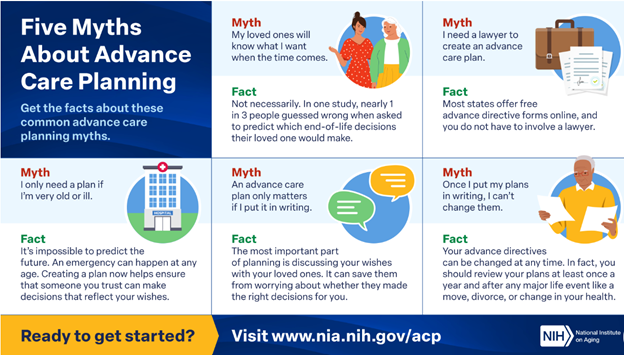
Reasons vary, but common misconceptions shown in the infographic below persist that hamper adult advance planning due to fear, procrastination, and a false sense of security, leading to neglected legal, medical, and financial preparations.
However, by naming trusted and capable individuals who are willing to serve as an agent and successor agent under a Power of Attorney, adults will be better assured that their preferences for care will be communicated and action taken to handle financial matters as directed without undue delay or the need for court proceedings. A little advance planning will also minimize guesswork and potential family disagreements should an emergency arise. See https://www.acpdecisions.org/19-evidence-based-benefits-of-advance-care-planning/.
Related resources
AARP
The Arc
Compassion and Choices
- https://compassionandchoices.org/ (end of life care)
The Conversation Project
- https://theconversationproject.org/
- Your Conversation Starter Guide
- Your Guide to Choosing Health Care Proxy
- Your Guide for Talking with a Health Care Team
- For Caregivers of People with Alzheimer’s or Other Forms of Dementia
- What Matters to Me Workbook
Family Caregiver Alliance
Five Wishes
National Institute on Aging
- Advance Care Planning: A Conversation Guide: https://order.nia.nih.gov/sites/default/files/2026-01/nia-advance-care-planning-guide.pdf
- Tips for Advance Care Planning: https://order.nia.nih.gov/sites/default/files/2024-07/tip-sheet-advance-care-planning.pdf
- Getting Your Affairs in Order Checklist: Documents to Prepare for the Future: https://www.nia.https://www.nia.nih.gov/health/advance-care-planning/getting-your-affairs-order-checklist-documents-prepare-future.gov/health/advance-care-planning/getting-your-affairs-order-checklist-documents-prepare-futurehttps://www.nia.nih.gov/health/advance-care-planning/getting-your-affairs-order-checklist-documents-prepare-future
Karen Alice Kloppe is a graduate of Illinois State University (B.A.) and the University of Illinois College of Law (J.D.). She is employed as the Legal Assistance Developer at the Illinois Department on Aging in Springfield, Illinois.
This message has been written by the author in her personal capacity for informational purposes only. It is not an official document of the Illinois Department on Aging or the State of Illinois.