Ethics Question of the Week: If I represent business buyer, can I represent seller in a separate matter?
Q. I currently represent the buyer of a business. Can I represent the business’s seller in a wholly unrelated matter?

Q. I currently represent the buyer of a business. Can I represent the business’s seller in a wholly unrelated matter?
Under the Illinois Eavesdropping Act as it existed prior to March 2014, citizens could be -- and were -- prosecuted for recording the police and other public officials without their consent. The new law, passed in December and codified at 720 ILCS 5/14 et seq., makes it legal to do so in public settings without consent. But other provisions of the law make it easier for police to obtain permission to record private citizens, and the sum total is drawing mixed reviews from different parties for different reasons.
The American Civil Liberties Union of Illinois (ACLU), which successfully challenged the old statute (American Civil Liberties Union of Illinois v. Alvarez, 679 F.3d 583 (7th Cir. 2012)), believes the rewritten law represents "a step forward" in that respect, says Adam Schwartz, senior staff counsel at the ACLU. "It limits the scope of the statute to just private conversations," he says. "If conversations are not private, there is no limit to recording; but if a conversation is private, you need all-party consent…. On the whole, the bill is drawing the line in the right place."
But the new act also provides a fast track for police to conduct surveillance on citizens' private communications if they have reason to believe those citizens will imminently commit one of a number of qualifying offenses, such as drug deals or sexual assaults, in the succeeding 24 hours. See 720 ILCS 5/14-3. Instead of requiring a warrant with approval of a judge, now police need only get the thumbs-up from their local state's attorney in a broader set of instances than in the past. Find out more in the June Illinois Bar Journal.
Associate circuit judges in Illinois outside Cook County have been evaluated in a poll of lawyers conducted by the Illinois State Bar Association. Results are available at www.isba.org/sites/default/files/judicialevaluations/2015%20Associate%20Reappointment.pdf
Associate judges are subject to reappointment every four years. The reappointment is accomplished through the casting of secret ballots by circuit court judges in their circuit. Successful candidates receive votes that tally three-fifths (60%) or greater in favor of their reappointment. Voting will be concluded prior to the beginning of the new associate judge terms. The new term of office for each reappointed associate judge will begin on July 1, 2015 and terminate on June 30, 2019.
Although the decision on associate judge reappointment is made by circuit judges, the ISBA is releasing these poll results to the public, because all judges are public officials and the opinions of their professional colleagues about their performance is of public interest.
ISBA attorneys in each judicial circuit (except Cook County) are mailed a ballot containing the names of every associate judge seeking reappointment in their circuit. Licensed attorneys who are not members of ISBA may request a ballot. Attorneys are asked to respond only if they have sufficient knowledge about the associate judge’s qualifications for judicial office to give a fair, informed opinion. Opinions expressed in the poll are of those attorneys who chose to respond and do not reflect the opinion of the ISBA or the opinion of all attorneys.
Asked and Answered
By John W. Olmstead, MBA, Ph.D, CMC
Q. I am the managing partner in a 12-attorney firm in Chicago. We have six partners and six associates. We are a boutique litigation firm. Three of our partners are in their mid to late 60s and should be thinking about retirement, but they seem to be in denial. How do we begin to address this issue?
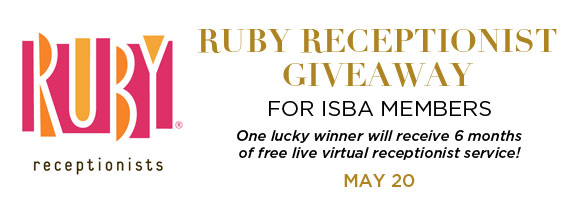 As part of Member Appreciation Month, our vendor partner Ruby® Receptionist is offering 6 months of FREE virtual receptionist service to 1 lucky member.
ENTER THIS 1 DAY ONLY DRAWING FOR A CHANCE TO WIN!
Ruby® Receptionists makes stellar impressions and sets your practice apart – at a fraction of the cost of an on-site employee. From their offices in Portland, Oregon, Ruby's live virtual receptionists handle your calls with care – using your custom greeting, transferring calls to you wherever you are, and answering basic FAQs about your firm.
You'll have the peace of mind that your clients will each be treated warmly and professionally by a smart, highly-trained, cheerful receptionist. Best of all, callers think Ruby works in your office.
AVAILABLE ANYTIME… ISBA members can sign up for a free 14 day trial.
After your free trial is over, sign up for 1 of Ruby's 3 different plans and, as an ISBA member, you'll also get the $95 set-up fee waived and 5% off the monthly service.
Do you have some understanding of insurance law, but want greater knowledge on the area, including recent developments in the law? Then join us via live webcast on Wednesday, June 3, 2015 for an in-depth look at several hot topic insurance coverage issues, including: how property insurance policies can impose examinations under oath (EUO) on the insured in the event of loss or damage; the various approaches defendants can take to reduce exposure and the risk of loss, including indemnity agreements and contractual insurance requirements; how courts are addressing policy language in the context of data breaches, hacking, and other cyber issues; and the insurance products designed to specifically address cyber and data risk issues.
The program is presented by the ISBA Insurance Law Section and qualifies for 2.25 hours MCLE credit.
The Lawyers' Assistance Program (LAP) will host a volunteer training on Friday, June 26 from 8:30 a.m. to 4:30 p.m. at Loyola University School of Law & the University of Illinois at Springfield.
The purpose of this training is to:
There is no charge for the training, but goodwill donations are accepted to help defray lunch costs. Limited space - registration required.
To register call the LAP office at 312-726-6607 or email at bmclaughlin@illinoislap.org.
We're celebrating you this month with FREEBIES, PRIZES & DISCOUNTS!

As part of Member Appreciation Month, we are offering current ISBA members 1 Free Section Membership!
Requirements/Restrictions:
Eek! It has happened again. Attorney Sam Seedy has lost his copy of the Rules of Professional Conduct while engaging in all types of social media activity – both in his personal and professional life – and needs help! Join us in Chicago on May 28, 2015 for a series of skits performed by high-energy and talented actors as they transport us to the fictional town of Nirvana City and showcase Sam’s ethical breaches. James Grogan, a renowned ethics expert, shows how the exercise of professional and moral judgment is well-guided by the basic principles underlying the Illinois Rules of Professional Conduct – which could’ve saved Sam from a wealth of ethical trouble!
The program is presented by the ISBA Energy, Utilities, Telecommunications, and Transportation Section and co-sponsored by Chicago Bar Association Committee on Energy, Telecommunications, and Water. It qualifies for 2.25 hours MCLE credit, including 2.25 hours Professional Responsibility MCLE credit (subject to approval).