

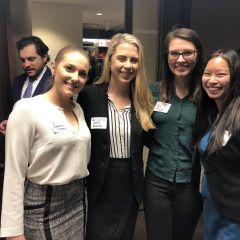
The ISBA Young Lawyers Division hosted speed networking and wine tasting events on Friday, Feb. 22, at the ISBA Mutual office in Chicago. Young lawyers, newly-admitted lawyers, and law students came together to sample and learn about wine, socialize, and network. Thank you to everyone who attended and our event sponsors!

ISBA members, sign up to receive The Bar News' biweekly e-newsletter by emailing emailpreferences@isba.org
-
February 25, 2019 | Events
-
February 25, 2019 |
Practice News
No time-management system magically, and overnight, turns you into a lean, mean, efficiency machine. But becoming more productive also doesn’t require mastering every page of a two-inch-thick time-management manual. Instead, try acquiring a single new skill and developing it over time, says Affinity Consulting partner Paul Unger in the Illinois Bar Journal’s March cover story, “Manage Your Time, or It Will Manage You.” In the article, Unger, who will be the featured speaker at the ISBA Solo & Small Firm Practice Institute on March 15 in Springfield, where he will present on time management, declutters the topic and also recommends his favorite best practices and methods.
-
February 25, 2019 |
ISBA News
The 2019 Annual Meeting will be held at the Grand Geneva in Lake Geneva, Wisconsin, from June 13–15, and you can now make your hotel reservations. To make reservations at the Grand Geneva, please call 855.833.5345 and reference reservation code #76s3q8 or indicate you are attending the Illinois State Bar Association's Annual Meeting. The deadline for making reservations for lodging is on or before May 13. Reservations received after this date will be subject to availability. The deposit will be forfeited for all no-shows, early departures, and cancellations less than seven days prior to arrival.
-
February 25, 2019 |
Practice News
The Illinois Supreme Court handed down one opinion on Friday, February 22. In Edwards v. Atterberry, the court denied a petitioner’s motion for a supervisory order but allowed him leave to file a complaint for writ of prohibition. Edwards v. Atterberry By Jay Wiegman, Office of the State Appellate Defender It is not very often that a group of appellate attorneys has difficulty determining whether an Illinois Supreme Court case is criminal or civil in nature. Edwards v. Atterberry, 2019 IL 123370, however, is such a case. After a jury found Edwards guilty of violating the Timber Buyers Licensing Act, a section of the Professions, Occupations and Business Operations Act (225 ILCS 735/1, et seq. (2016)), he filed a motion for supervisory order and for leave to file a writ of prohibition seeking to prohibit Judge Atterberry from conducting a sentencing hearing or from taking any other action in the underlying criminal case. Edwards claimed that because he was charged with violating regulations rather than a statute defining a criminal offense, the circuit court lacked subject-matter jurisdiction. The supreme court denied the motion for a supervisory order but allowed Edwards leave to file a complaint for writ of prohibition.
-
February 21, 2019 |
CLE
Don’t miss this full-day seminar on March 15 in Springfield that gives you all the information you need to take your technology to the top. Topics include: how to build your social media presence to bring in more clients and enhance your reputation; how to better manage your staff; the correct way to use encryption, email, passwords, and more; how to make the most of your technology budget; how to avoid being overloaded by technology and create a better system for communicating with staff and clients; the need for civility in the legal profession; how to move beyond your limits of liability; which iPad apps you need in your practice; and the necessary fundamentals for your website.
-
February 21, 2019 |
Member Services
It’s no secret that a document assembly system is a cure-all for document-intensive areas of practice. Attorneys in practices such as estate planning, real estate, contracts, banking, and employee benefits can greatly benefit from automating their document production process. It’s one of the few technologies that can actually revolutionize the way you work.
-
February 20, 2019 |
Practice News
ISBA Director of Legislative Affairs Jim Covington reviews legislation in Springfield of interest to ISBA members. This week he covers special interrogatories, appearances by corporate officers, evictions, experts in adult guardianship reports, relocation in the IMDMA, condos and community associations, condos, public guardian fees, maintenance and veterans’ benefits, Cook County subcircuit judgeships, and Cook County associate judgeships. Special interrogatories. House Bill 2233 (Thapedi, D-Chicago) repeals Section 2-1108 of the Code of Civil Procedure allowing special interrogatories in verdicts. House Bill 2233 is assigned to the House Judiciary Committee.1 comment (Most recent February 22, 2019)
-
February 20, 2019 |
Practice News
Asked and Answered By John W. Olmstead, MBA, Ph.D, CMC Q. I am the sole owner of a five-attorney litigation firm in Mesa, Arizona. I started the firm 12 years ago after leaving a large firm. I was an income partner in that firm. For a few years I operated as a solo with a legal assistant. Then I began adding associates and staff. Now we have four associates, an office manager/bookkeeper, two paralegals, and two legal assistants. Our annual gross fee revenues are around $1.2 million, the overhead is high, and my net income is not all that much more than what I was making as a solo. My associates aren’t willing to put in the time to generate the billable hours that we need. Then there is the time and stress of managing all of this. Is growth a good thing?
-
February 19, 2019 |
Practice News
By Missy Greathouse Dispute Resolution Institute, Inc. (DRI) has provided pro bono family mediation services to the first judicial circuit for the last nine years and is the only pro bono mediation organization available to the courts and families in southern Illinois.
-
February 19, 2019 |
Practice News
Blockchain may dramatically reduce the cost of processing mortgage applications and provide for transparent, secure transactions and efficient recordkeeping. But the strengths and limitations of blockchain should be better understood before replacing a title system that has been in place for more than 140 years in Illinois, argues Paul Peterson in his February 2019 article, “Problems Blockchain Doesn’t Solve,” for the Illinois Bar Journal. Peterson, vice president and senior underwriter for the Fidelity Family of Title Insurers, vice-chair of ISBA's Construction Law Section Council, and a member of ISBA's Real Estate Law Section Council, outlines record-validating problems that blockchain technology has yet to crack.