

Illinois State Bar Association President John G. Locallo (left) presents Mark Pleasant, a special investigator with the Lake County State’s Attorney’s office in Waukegan, with the ISBA’s annual Law Enforcement Award. This award was presented at a luncheon of the Lake County Bar Association on April 24 at the Green Belt Cultural Center in North Chicago.

ISBA members, sign up to receive The Bar News' biweekly e-newsletter by emailing emailpreferences@isba.org
-
April 25, 2012 |
ISBA News
-
April 25, 2012 |
Practice News
Asked and AnsweredBy John W. Olmstead, MBA, Ph.D, CMCQ. I am a partner in a 16 attorney firm in Memphis. Our firm has had the same partner compensation system for 20 years and we are generally happy with it. It is an eat-what-you-kill system. Since we are generally happy why should we consider changing it?A. You can start with the following firm self-test. Has the firm experienced or is it experiencing:Partner defectionsFirm splits and breakupsPersonal fiefdomsMaverick partnersHoarding workSystem perceived as unfairProblems acquiring and retaining top legal talentLow productivityLow profitabilityClient dissatisfactionLow moraleDisputes with former partnersIf your firm is experiencing or has experienced the above symptoms, it is time to really examine where the firm is headed and what messages your compensation is sending to your partners. Is the firm trying to be a firm or merely a group of lone rangers? Even though your partners are content, your compensation system may be holding the firm back from becoming all that it desires to be. Contentment may not be the best measure of success.Click here for our blog on compensationClick here for our published articles
-
April 20, 2012 |
Practice News
"Medical Negligence and The Law" and "Negligence and The Law" will air on Chicago Access Network Television, Channel 21 in Chicago, at 10 p.m. in April and May."Medical Negligence and The Law" will air on on Tuesdays, April 24 and May 8. Appearing on the show are (from left) Ronald Kalish, of Steinberg, Goodman & Kalish in Chicago; Karen McNulty Enright, of Winters Enright Salzetta & O’Brien, LLC, in Chicago; Hon. Elizabeth M. Budzinski, a judge in the Circuit Court of Cook County; and program moderator Samuel A. Kavathas, of Kavathas & Castanes in Chicago."Negligence and The Law" will air at 10 p.m. on Tuesdays, May 1 and 15. Appearing on the show are program moderator Samuel A. Kavathas, of Kavathas & Castanes in Chicago; Ronald Kalish, of Steinberg, Goodman & Kalish in Chicago; Karen McNulty Enright, of Winters Enright Salzetta & O’Brien, LLC, in Chicago; and Hon. Thomas V. Lyons, a judge in the Circuit Court of Cook County.
-
April 19, 2012 |
Practice News
Our panel of leading appellate attorneys review Thursday's Illinois Supreme Court opinions in the criminal cases People v. Clemons, People v. Hunt, People v. Dominguez and People v. Edwards.People v. ClemonsBy Jay Wiegman, Office of the State Appellate DefenderAt first blush, it seems a simple axiom: the punishment should fit the crime. Figuring out when a penalty is disproportionate to the offense, however, has long been a thorny issue, particularly because the Legislature has adopted several overlapping provisions that enhance the length of sentences based on the involvement of firearms in offenses. As a result, criminal defendants frequently argue that their punishment violates the proportionate penalties clause of the Constitution where they receive a sentence that exceeds the range of sentences applied to other cases that are identical to the offense of which they were convicted. In 2007, the Illinois Supreme Court held that "common sense and sound logic dictate that the penalties for identical offenses should be identical." People v. Hauschild, 226 Ill. 2d 63. Thus, In Hauschild, the Supreme Court held that "the sentence for armed robbery while armed with a firearm violates the proportionate penalties clause because the penalty for that offense is more severe than the penalty for the identical offense of armed violence predicated on robbery with a category I or category II weapon.” Hauschild, 226 Ill. 2d at 87.
-
April 19, 2012
"A gradual shift in how Illinois courts are deciding cases involving negligent-product-design claims appears to be evolving following the Illinois Supreme Court’s recent ruling in Jablonski et al. v. Ford Motor Co.," George Bellas and Patrick Andes write in the latest ISBA Bench and Bar newsletter. The new direction "bodes ill for plaintiffs," the authors say. Find out why.
-
April 19, 2012
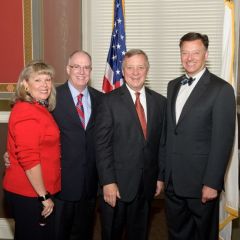 ISBA leaders traveled to Washington, D.C. this week to lobby Congress on increased legal aid funding.
 -
April 18, 2012 |
Member Services
Protecting your assets is very important to you. After all, you have worked your whole life to obtain them. Your ISBA membership and GEICO are here to help.GEICO and ISBA are proud to be working together to offer exceptional insurance products and a great savings opportunity on GEICO auto insurance to members of ISBA. As an ISBA member, you could qualify for an exclusive discount. When you consider the fact that new GEICO policyholders report average annual savings of over $500, you could be saving a lot of money. But there’s more to GEICO than just great rates. GEICO policyholders receive 24/7, professional, courteous service. When it comes to claim handling, GEICO is able to settle many claims within 48 hours of being reported, and sometimes a check can even be written on the spot. That’s why GEICO customers report a 97% customer satisfaction rate. As a subsidiary of Warren Buffett’s Berkshire Hathaway Inc, GEICO has the stability of a company you can trust. Savings, service, and reliability? They can all be yours.Simply go online to http://www.geico.com/bar/isba or call 800-368-2734, to complete a simple, no-obligation rate quote. Don’t forget to mention your ISBA affiliation to see how much you could save with your exclusive member discount. GEICO can help you with your insurance needs and help you obtain competitive rates on homeowner’s, renter’s, condo, motorcycle, boat, PWC, ATV, and RV insurance.As an added bonus, every time a member of ISBA completes a quote for automobile insurance, GEICO supports the ISBA’s programs and services.
-
April 18, 2012 |
Practice News
Asked and AnsweredBy John W. Olmstead, MBA, Ph.D, CMCQ. I am sole owner of a law firm in Chicago with an elder law practice. I have two paralegals and two legal assistants. Although I want to continue to practice as long as I can I am in my late 60s and am beginning to think about what to do with my practice. I have recently had several discussions with another sole owner that is interested in buying my practice. Since I want to practice as long as I can I am concerned about the timing of selling my practice due to the current ethical rules. I also want to insure that the other firm would be the right fit for my clients and staff. Do you have any thoughts or suggestions?A. Making the right decision concerning the "Who" is usually more important than the "What" or the "How". Take your time to do the proper due diligence regarding the other firm. Get to know the owner as well as the employees of the other firm. Ascertain practice, client, and cultural compatibility. If you both determine that a a deal might make sense - then move to the "How."
-
April 16, 2012 |
ISBA News | Practice News
"Medical Negligence and The Law" and "Negligence and The Law" will air on Chicago Access Network Television, Channel 21 in Chicago, at 10 p.m. in April and May. Illinois Law is a cable production of the Illinois State Bar Association (ISBA) and can also be viewed online at iln.isba.org/blog/illinois-law-video."Medical Negligence and The Law" will air on on Tuesdays, April 24 and May 8. Appearing on the show are (from left) Ronald Kalish, of Steinberg, Goodman & Kalish in Chicago; Karen McNulty Enright, of Winters Enright Salzetta & O’Brien, LLC, in Chicago; Hon. Elizabeth M. Budzinski, a judge in the Circuit Court of Cook County; and program moderator Samuel A. Kavathas, of Kavathas & Castanes in Chicago."Negligence and The Law" will air at 10 p.m. on Tuesdays, May 1 and 15. Appearing on the show are program moderator Samuel A. Kavathas, of Kavathas & Castanes in Chicago; Ronald Kalish, of Steinberg, Goodman & Kalish in Chicago; Karen McNulty Enright, of Winters Enright Salzetta & O’Brien, LLC, in Chicago; and Hon. Thomas V. Lyons, a judge in the Circuit Court of Cook County.The 33,000-member organization, with offices in Springfield and Chicago, provides professional services to Illinois lawyers, and education and services to the public.
-
April 16, 2012 |
Practice News | Events
Anyone in Illinois with a question about a legal matter can call and talk to a lawyer – at no cost – on Ask A Lawyer Day, Saturday, April 28.Lawyer volunteers will answer phones at 5 locations from 9 a.m. to 2 p.m. Any Illinois resident can call toll free, or a local number in some areas, for a free phone consultation with a lawyer.The 31st annual Ask A Lawyer Day, part of Law Day activities in Illinois, is a public service sponsored by the Illinois State Bar Association (ISBA) in cooperation with bar associations in Chicago, DuPage County, Lake County and Will County.Lawyer volunteers will be able to answer questions about consumer problems, family law, estate planning, personal injury, or any other legal situations affecting individuals.Callers will be advised of steps they can take to resolve their legal problems and, if they need additional legal services, they will be advised to see their lawyer. If they don’t have a lawyer, they can receive a referral to a lawyer who practices in their area through the referral service offered by participating bar associations.“We find that many people hesitate to see a lawyer, even when they know they have a legal problem,” said John G. Locallo, of Chicago, president of the Illinois State Bar Association. “Ask A Lawyer Day provides an opportunity to learn about a legal situation, or how best to address a legal problem, in a user friendly manner.”Phone numbers to talk to a lawyer on April 28 are: