
Joint Secretary of State and Supreme Court Restoration Project of Illinois Attorney Oaths Complete
A long-term restoration project between the Illinois Secretary of State Jesse White’s office and the Supreme Court of Illinois has led to the discovery of some rare, historic documents involving famous and infamous Illinois attorneys.
“I am pleased with the results of this project, which sought to restore and preserve a unique facet of our state’s history,” said White, who also serves as State Archivist. “Since 2010, the State Archives Department has been restoring attorney oaths for the Supreme Court. Approximately 142,000 oaths, some preceding the Civil War, have been restored.”
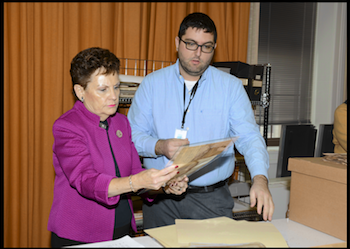 Illinois Supreme Court Chief Justice Lloyd A. Karmeier said, “The Court recently had the opportunity to tour the State Archives and see, firsthand, the efforts being made there to conserve these important documents. Attorney oaths offer scholars, educators and students a very tangible, but very fragile connection to the lawyers who have helped shape our laws and the legal profession over the past two centuries. The Court is extremely grateful to the Archives for everything it has done to ensure that this irreplaceable record of the legal profession’s history is preserved and protected for future generations. The work done by the Archives’ staff has been nothing less than extraordinary.”
 Asked and Answered
  "This past January, many newspapers carried stories of lawyers at airports, including O'Hare, offering assistance to immigrants and their families in light of the January 17 Presidential Executive Order on immigration," ISBA General Counsel Charles Northrup writes in the April Illinois Bar Journal. "The stories were often accompanied by photos of lawyers holding up hand-written signs saying things like 'Need a Lawyer?' or 'Lawyers Here to Help.'"
 Back by popular demand! Learn the tips of the trade as several panels of federal judges, retired federal judges, and mediators share everything you need to know about settlement in the federal courts. Attorneys with all level of experience practicing in the U.S. District Court for the Northern District of Illinois and the Seventh Circuit Court of Appeals who attend this seminar in Chicago on May 10, 2017 will gain a better understanding of: meeting the judges’ expectations for pre-settlement preparations; preparing your client for settlement; how to conduct the settlement conference, including conference procedures and techniques to help both parties come to a settlement agreement; what not to do during a settlement; how to handle settlement compliance issues and the court’s ability to enforce the settlement agreements; and the Seventh Circuit’s settlement program procedures.
 Don’t miss ISBA’s 16th Annual Illinois Environmental Law Conference in Chicago on May 4-5, 2017!