The Cook County Board of Commissioners is seeking applicants for the Cook County Public Defender position.
The term of office for the current Cook County Public Defender expires on March 31, 2021.


The Cook County Board of Commissioners is seeking applicants for the Cook County Public Defender position.
The term of office for the current Cook County Public Defender expires on March 31, 2021.

The Illinois Supreme Court today issued a new order in eviction cases. The order is a follow-up to the order the Court issued in May setting forth the requirements for any landlord seeking to evict a tenant from a dwelling unit covered by the CARES Act.

The U.S. and Illinois constitutions guarantee the accused the right to a speedy trial. A defendant not tried within the appropriate period is entitled to release from custody and dismissal of the charges. But can the right to a speedy trial be extended by the judiciary as an exercise in public health and welfare? The question is pursued by attorney Donald J. Ramsell in his December 2020 Illinois Bar Journal article, “Bad Timing.”
The Illinois Supreme Court today announced the approval of Order M.R.18368, which provides a timeline for the expansion of the Remote Access Policy (RAP) for Illinois licensed attorneys and legal services providers in User Group 5.
The Illinois Supreme Court issued one opinion on December 17. In Barrall v. The Board of Trustees of John A. Logan Community College, the court interpreted a provision in the Public Community College Act governing the “bumping rights” of laid-off tenured faculty members.
The Illinois Supreme Court today issued new Rule 44, which addresses cameras in the courtroom and is effective immediately. The Court also amended Rule 63 to delete its language about cameras in the courtroom.
The Supreme Court of Illinois Judicial College and the U.S. District Court, Central District of Illinois, announced today the completion of its annual State & Federal Seminar (Seminar) which engages federal and state judges in lively conversation concerning pressing legal topics. The Seminar took place in the form of six webinar sessions from June through December 2020 and for the first time was held entirely online.
The Illinois Supreme Court has appointed Scott J. Szala of Chicago to serve as a member of the Attorney Registration & Disciplinary Commission (A.R.D.C.) Review Board effective on January 1, 2021, and expiring on December 31, 2023. The A.R.D.C. is the Supreme Court agency that investigates allegations of lawyer wrongdoing in Illinois.
The Illinois Supreme Court has appointed Drinda L. OConnor of Springfield to serve as a Commissioner of the Attorney Registration & Disciplinary Commission (A.R.D.C.) effective on January 1, 2021, and expiring on December 31, 2023. The A.R.D.C. is the Supreme Court agency that investigates allegations of lawyer wrongdoing in Illinois.
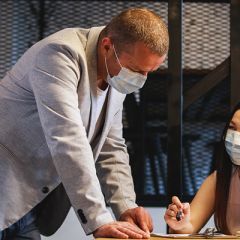
COVID-19 has brought new issues and questions to light when it comes to employment law. Do employers have a duty to protect their employees from viral diseases such as COVID-19? When it comes to employment law, one typically can recover under workers’ compensation. But the Workers’ Compensation Act limits the amount of damages employees can recover from employers—even when these damages are often not enough. In their December 2020 Illinois Bar Journal article, “Workers’ Comp, Negligence, and COVID-19,” past ISBA President Hon. Russell W. Hartigan (ret.) and Sarah Norkus examine how Illinois courts have held that employers must provide employees with a reasonably safe place in which to work and use reasonable care to provide for their employees’ safety. However, relying upon the Act to collect COVID-19-related damages will not be easy. And other routes may be worth pursuing when seeking negligence-related injuries on the job before moving ahead with a workers’ compensation claim.