

Join us in Chicago on November 7th for a look at seven different practice areas and how to successfully handle these types of cases! Practitioners working in the civil litigation arena need to stay up to date on a number of legal topics, including construction accidents, insurance issues, medical malpractice, employment law, government liability, vehicular collision, and foreclosure actions. Attorneys and law students with all levels of experience who attend this half-day seminar will gain a better understanding of how to handle cases from each of these areas and learn how to: obtain necessary discovery; handle insurance coverage disputes and declaratory judgments; identify proper parties in a medical malpractice claim; address non-compete and whistleblower issues; present liability and damage issues in motor vehicle collision cases; represent a client undergoing foreclosure actions; and much more!The seminar is presented by the ISBA Civil Practice & Procedure Section and qualifies for 3.50 hours MCLE credit.Click here for more information and to register.

ISBA members, sign up to receive The Bar News' biweekly e-newsletter by emailing emailpreferences@isba.org
-
October 24, 2014 |
CLE
-
October 24, 2014
 The Illinois Bar Foundation hosted its 16th Annual Gala on Friday, Oct. 17 at the Four Seasons in Chicago. ATG President and CEO Peter Birnbaum was honored with the Distinguished Award of Excellence.
 -
October 23, 2014
Last June, the ISBA surveyed members about their practice setting, compensation, and benefits. What are the most popular practice areas? How much money do survey respondents take home? What average billing rates did they report? How many work for firms of a given size? How many hours do they work? Find out in the November Illinois Bar Journal.
-
October 23, 2014 |
Practice News
Q. If I run for judicial office, as a lawyer (and not a sitting judge) do I have to comply with the Code of Judicial Conduct?A. RPC 8.2(b) provides that a lawyer who is a candidate for judicial office shall comply with the applicable provisions of the Code of Judicial Conduct. In addition, Rule 67 of the Code of Judicial Conduct makes it applicable to candidates as well as sitting judges.ISBA members can browse past ISBA Ethics Opinions, access our Ethics Hotline, and other resources on the ISBA Ethics Page.
-
October 23, 2014 |
Practice News
The Illinois Supreme Court announced Thursday the appointment of veteran attorney Edward J. King as Cook County Circuit Judge in the Fourth Judicial Subcircuit.
-
October 23, 2014 |
ISBA News
The Illinois State Bar Association Standing Committee on Delivery of Legal Services is seeking nominations for the ISBA Joseph R. Bartylak Memorial Legal Services Award which honors the extraordinary commitment and dedication of a civil legal services attorney who has provided the highest caliber of compassionate legal representation and outstanding service to Illinois’ vulnerable and low-income population.Nominations must be received by Friday, March 6, 2015. For more information on this award and how to nominate an individual, please visit the Joseph R. Bartylak homepage.The Illinois State Bar Association’s Standing Committee on Delivery of Legal Services is also seeking nominations for the ISBA John C. McAndrews Pro Bono Service Award.The ISBA has established the John C. McAndrews Award to honor the extraordinary commitment of individuals, bar associations, or law firm/corporate legal departments to providing free legal services to the income eligible in Illinois or expanding the availability of legal services to the income eligible in Illinois.
-
October 23, 2014
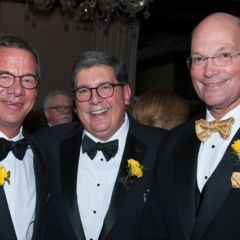 The Illinois Bar Foundation hosted its 16th Annual Gala on Friday, Oct. 17 at the Four Seasons in Chicago. ATG Trust President and CEO Peter Birnbaum was honored with the Distinguished Award of Excellence.
 -
October 22, 2014 |
Practice News
The Illinois Supreme Court announced Thursday the appointment of longtime Associate Judge Marianne Jackson to fill a Cook County vacancy in the Seventh Judicial Subcircuit. Prior to her service on the bench, Judge Jackson worked as an attorney in the public sector and as a solo practitioner for 24 years.
-
October 22, 2014 |
Practice News
Asked and AnsweredBy John W. Olmstead, MBA, Ph.D, CMCQ. I am the managing partner of a 5 attorney general practice firm in Kansas City, Missouri. My book of business is down and I have been considering taking on insurance defense work. During the past year I had the opportunity of working as co-counsel on a couple of insurance defense matters and enjoyed the experience and the work. It seems to me that representing insurance companies would represent a steady flow of work. I would appreciate your thoughts.
-
October 21, 2014 |
ISBA News | Events
St. Clair County Sheriff Richard Watson (second from left) received a 2014 Law Enforcement Award from the Illinois State Bar Association (ISBA) during a ceremony hosted by the St. Clair County Bar Association at The Weingarten restaurant in Belleville on October 16.On hand for the presentation were (from left) Nick Kujawa, who nominated the Sheriff for the award; Sheriff Watson, Russell Scott, a member of the ISBA Board of Governors, who presented the award; and Jon Rosenstengel, president of the St. Clair County Bar Association.