

Our panel of leading appellate attorneys reviews the six Illinois Supreme Court opinions handed down Thursday, May 19.

Practice News
-
May 19, 2022 | Practice News

-
May 19, 2022 | Practice News

The Illinois Supreme Court announced the filing of lawyer disciplinary orders on May 19, 2022. Sanctions were imposed because the lawyers engaged in professional misconduct by violating state ethics law.
-
May 16, 2022 | Practice News

The Illinois Courts Commission (Commission) announced today that it has hired Shelley M. Bethune as its first Executive Director and General Counsel. Ms. Bethune will serve as the head of the agency and will supervise its day-to-day operations. Her first day will be June 1, 2022.
-
May 16, 2022 | Practice News

The Illinois Supreme Court Commission on Access to Justice and the Administrative Office of the Illinois Courts have launched an application process for two grant initiatives and to begin an expansion of the network of court personnel who assist self-represented litigants (SRLs). The application process for both grant initiatives is open now through June 21, 2022.
-
May 16, 2022 | Practice News

Even when reports are made and charges are filed, cases involving domestic violence are notoriously difficult to prosecute, states Charles Golaszewski in his May Illinois Bar Journal Article, “Propensities, for Evidence and Violence.” Given that domestic violence occurs between family and household members, most of the abuse takes place in the home, meaning that eyewitnesses to specific incidents are rare. Since most victims do not seek medical treatment following incidents of abuse, prosecutors commonly lack documentation of physical injuries to corroborate a victim’s allegations. In domestic violence prosecutions, corroboration in any form is hard to come by, which, in turn, makes it difficult for a fact finder to find a defendant guilty beyond a reasonable doubt.
-
May 13, 2022 | Practice News
The Illinois Supreme Court announced today that Justice Kathryn E. Zenoff, a circuit judge of the 17th Circuit currently assigned to duty in the Second District Appellate Court, has been reassigned to duty in the Fourth District Appellate Court until further order of the Court, effective June 1, 2022.
-
May 10, 2022 | Practice News

Every litigant in a civil action in Illinois has a statutory right to seek a change of judge without cause. But a judicially created constraint commonly known as the “test the waters doctrine” often limited a party’s ability to invoke the right to change judges. Recently, the Illinois Supreme Court abolished the test the waters doctrine expanding a litigant’s statutory right to change judges without cause, writes Daniel J. Karrison in his May Illinois Bar Journal article, “Test the Waters Doctrine Sinks.”
-
May 10, 2022 | Practice News
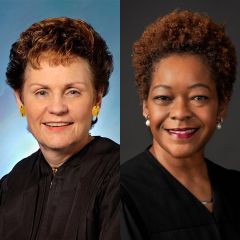
Trailblazing Justice Rita B. Garman has announced her retirement from the Illinois Supreme Court effective July 7, 2022. Justice Garman, 78, has served on the Supreme Court since 2001 and retires as the longest serving judge in Illinois. She served as Chief Justice of the Supreme Court from 2013 to 2016. Read Justice Garman’s full statement on her retirement.
-
May 9, 2022 | Practice News
The bar admission ceremony for the 292 new attorneys who passed the February 2022 Bar Exam will be held online on Thursday, May 12, at 11:00 a.m. Chief Justice Anne M. Burke will preside over the ceremony and administer the oath to the new admittees. Justice P. Scott Neville will make the motion to admit the class and Justice Robert L. Carter will second the motion.
-
May 5, 2022 | Practice News | ISBA News

The Illinois State Bar Association invites you to subscribe to "Life and Practice" – a brand new ISBA-sponsored podcast hosted by ISBA member Natali Thomas and her cohost Jessica Sisler – premiering this Friday, May 6, 2022.
1 comment (Most recent May 5, 2022)