

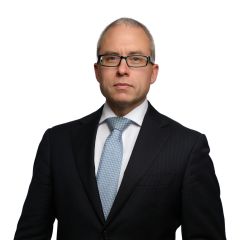
CHICAGO — Aronberg Goldgehn is pleased to announce the addition of Ralph Dado, a partner from Kirkland & Ellis LLP’s Chicago office, to lead Aronberg’s new White Collar Investigations, Risk & Integrity practice group. Over 15 years at Kirkland, Dado has become a national leader in investigations for both companies and institutions, high-stakes white collar defense, and crisis management. Dado’s practice also specializes in helping companies prevent and respond to catastrophic safety events and in conducting high-profile research integrity investigations.
ISBA members, sign up to receive The Bar News' biweekly e-newsletter by emailing emailpreferences@isba.org
-
September 16, 2025 | People
-
September 16, 2025 |
Practice News
By Andrew Sharp, Esq.2 comments (Most recent September 24, 2025)
-
September 16, 2025 |
Events
CARBONDALE, Il. — More than 250 Southern Illinois University Carbondale first-year professional students confronted and discussed current ethical legal and medical issues together at the SIU Simmons Law School.
-
September 15, 2025 | People | ISBA News
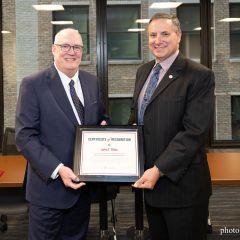 The Illinois State Bar Association is pleased to introduce the John E. Thies Excellence in Legal Education Award. Illinois Supreme Court Justice David K. Overstreet presented Past President John E. Thies (2012-13) with a Certificate of Recognition during the first day of the NextGen Symposium 2025, which was held at the ISBA Regional Office.1 comment (Most recent October 2, 2025)
 -
September 15, 2025 | Practice News
 Using generative artificial intelligence (GAI) models to detect logical (and illogical) patterns in text is one of its quiet superpowers. In this September Illinois Bar Journal article, “Your Socratic Sidekick,” Patrick T. Barone shows how GAI tools, guided with carefully crafted prompts, enables lawyers to simulate the probing questions of a seasoned professor.
 -
September 13, 2025 | Events
 On September 11, 2025, the ISBA Sports and Entertainment Law Section members enjoyed an evening of fun, food, and women’s basketball as the Chicago Sky took on the New York Liberty at the Wintrust Arena, 200 E Cermak Rd, Chicago. 🏀
 -
September 11, 2025 | Events
 We honored ISBA President 2024-25, Sonni Choi Williams, and IBF President 2024-25, John L. Nisivaco, for their service to the Illinois State Bar Association, the Illinois Bar Foundation, and the legal community on Thursday, September 4, 2025, at Embers, 933 S. State Street, in Lockport.
 -
September 10, 2025 | Practice News
 Justice David K. Overstreet and the Illinois Supreme Court have announced the assignment of the Honorable Robert C. “R.C.” Bollinger to the Fifth District Appellate Court. Judge Bollinger is being assigned to fill a newly created vacancy on the Fifth District Appellate Court. The assignment is effective September 29, 2025, and will continue until further order of the Court.
 -
September 9, 2025 | Practice News
 The Illinois Department of Children and Family Services (DCFS) is accepting applications for two attorney positions.
 -
September 9, 2025 | Practice News
 The Illinois Supreme Court has selected Justice P. Scott Neville, Jr. as the 123rd Chief Justice. He will be the second Black Chief Justice in Illinois history, following the late Justice Charles E. Freeman, who served from 1997 to 1999. His three-year term begins on October 26, 2025, succeeding Chief Justice Mary Jane Theis, who has led the Court since 2022.